
Christmas 2022
December 3 @ 10:00 am – 3:00 pm
€30
Margaret Aylward Centre
Advent is about waiting and listening in order that we may hear the Divine whisper that contains the promise of something more. This is always an adventure that keeps us on tiptoe in our spirits. So let’s wait and listen and share together at this…
Contact
The Margaret Aylward Centre for Faith and Dialogue,
Holy Faith Sisters, Glasnevin, D11 TC21
Tel : (01) 797 9364 | Mob: 087 664 9862 Email: info@macfd.ie

ISBN: 978 1 80097 016 8
Price: €9.99/£8.99
‘A Traveller Passing Through is more about an inner journey
by a pilgrim to sacred places, recalling people and events in the
Holy Land and then interpreting them in a creative,
refreshing and prophetic way as good news to our modern world.
The transforming word of God, which is challenging, is incarnated
in the human story calling for growth in inner freedom and to
awaken a vision that sees beyond the ordinary to welcome and
live the deeper gifts of unity and peace that the Lord desires for us’.
Father Michael Drennan
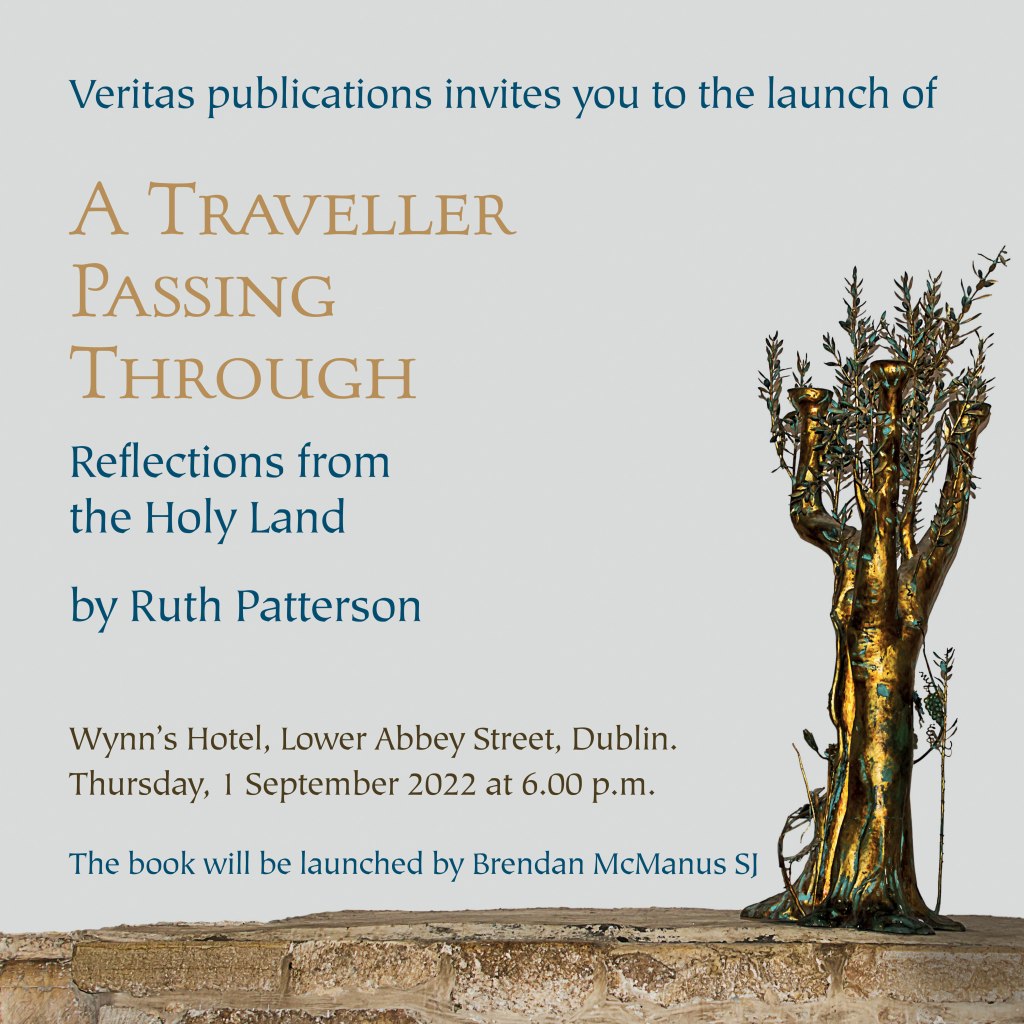
A Traveller Passing Through
Reflections from the Holy Land
Ruth Patterson
About the book
In A Traveller Passing Through, Ruth Patterson invites readers to
accompany her on a pilgrimage to the Holy Land and the sites of
significant moments in the life of Jesus. This book enables
readers to journey through these experiences and, in doing so,
opens a door to a deeper appreciation of our own brokenness
and belovedness and to the gift of exploring the mystery and
wonder of the spiritual journey.
Year : 2022
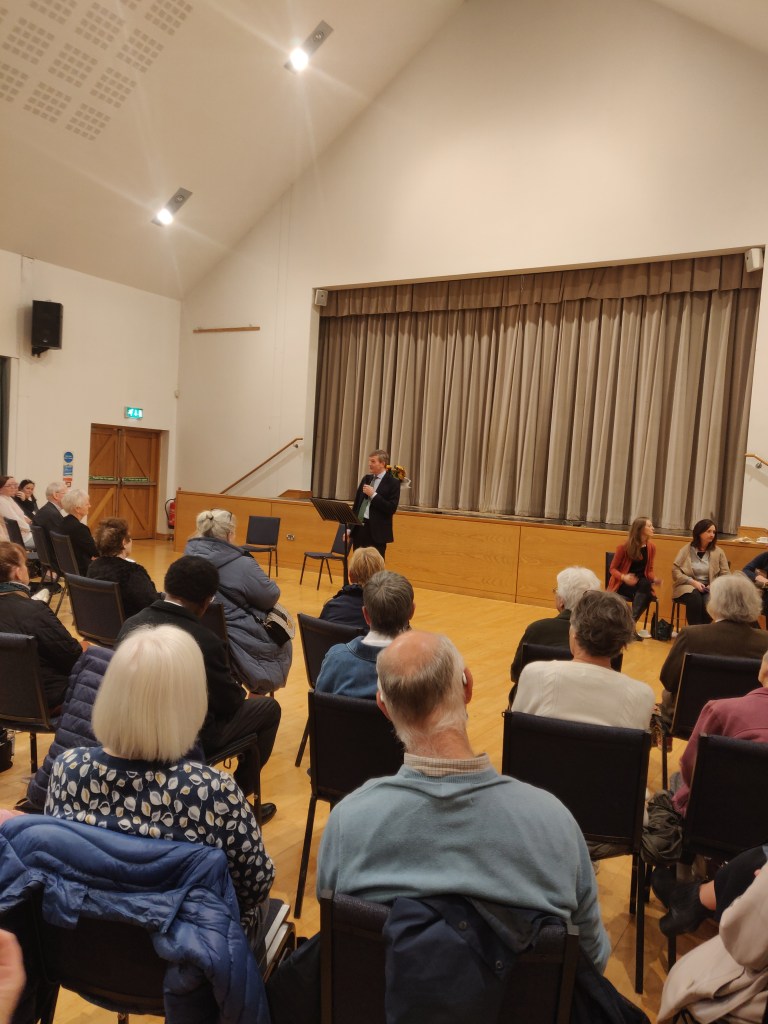

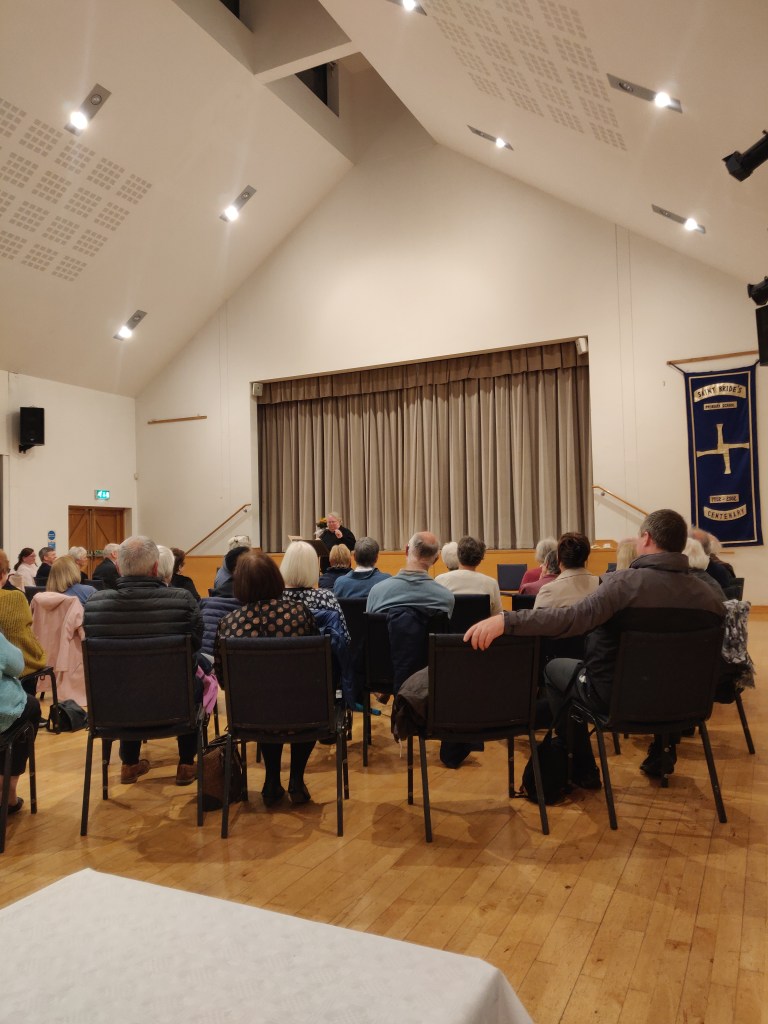
Rev Steve Stockman launching the book
RM Chairman Mr Michael Fitch speaking at the launch

Rev Steve Stockman
MY SCRIPT AS I LAUNCHED A TRAVELLER PASSING THROUGH
I have never been to the Holy Land, well not the real one anyway! There are a few streets around Fitzroy but that’s not where Ruth is writing about.
Yet, as a preacher, every Sunday I imagine Holy Land scenes. Bethlehem, Galilee, Nazareth, Capernaum, Jerusalem and the places of Jesus journey’s in between. If the Lord spares me, to quote my Granny, I would love to see those places where Ruth stood in 2018.
For the time being, Ruth’s book will do.
A Traveller Passing Through; Reflections from the Holy Land is what it says in the tin – the reflection of a pilgrimage. There is a diary feel to it. So we start, usually in the morning on a bus! And we go places. Holy places. I loved it.
Yes I loved Galilee, on the lake. I mean “The sea Of Galilee is tranquil, sparkling blue. We have already been on a boat trip that gifted us with a glimpse of the eternal ‘now’ of presence.” Oh, I’m jealous. Somewhere else on its shore, the sand between her toes.
Those last words are very Van Morrison who can get into a near spiritual rant on stage – the eternal NOW… the eternal NOW.
I have to admit I was kind of put off the busyness of Bethlehem and Jerusalem but the hustle and bustle has to be a big part of it!
I loved the poetic, imaginative energy of Ruth’s writing. For example at Jesus birth she has out on the hillside with those marginalised shepherds and writes,
“When we hear the familiar words, we are, in a timeless moment, transported back to that night when the heavens blazed with stars and the night was filled with a song of hope that reverberates down the centuries and awakens hardened hearts or minds imprisoned by scepticism to the thought that maybe, just maybe it happened. Maybe, just maybe, this world is more than we know. Maybe, just maybe, there is a spiritual dimension, there are armies of heaven’s angels under the command of God whose nature is always love.”
WOW!
Or at the other end. In the Upper Room, doubling as the place of Jesus washing feet, the Last Supper and hiding after the crucifixion … the disciples leave it for the ascension and Ruth writes,
They too leave the Upper Room, as we did. I have an image of the unstoppable energy spiralling outwards through Jerusalem, Judea, Samaria and the endless beyond.”
There are threads running through the reflections. Awakening and Unlearning are but two. Ruth Patterson has an amazing awareness of our inner terrain. She has a real gift at seeing the right questions that faith asks of our lives – Who are we? Why are we here? Who is Jesus? How does he make a difference?
I will illustrate it with a close look at my favourite chapter, as I pull this launch into an epilogue or sermonette.
Ruth might be surprised but my very favourite chapter was the one around and in Jericho. The bus hasn’t even got to Jericho before Ruth is painting pictures.
The heat of the sun. The rugged terrain. Rocky. Dry. Dusty. The isolation. The vulnerability of a traveller on a journey that Jesus knew well. I feel she has taken me there. I am checking I don’t get dust on my trousers.
Ruth sees the Good Samaritan Inn and it leads us into that favourite parable of Jesus. What’s not there Ruth is asking again. She wants to know what happened the wounded man, how did the hotelier care for him. Did the Samaritan return. Like a good TV series ending – what happened next?
Oh I’d like then to go on into Jericho and sit below Zacchaeus’ Olive Tree and see how he has to “come down” and “let go”. I’ll leave that for you because I want to end back in the Good Samaritan bit.
Ruth preaches on something I never have – the Inn. She opens up the Gospel importance of hospitality and I believe she is really onto something. She writes, “The whole concept of hospitality is at the core of the Gospels, hospitality between us and God, between the alienated parts if our own inner beings, between ourselves and others, and between ourselves and all creation”
I am so annoyed that I started this chapter this week because on Sunday I had just ended a series of preaching where I looked at sin as a pushing away of God, neighbour, enemy, creation and self. The Gospel, Ruth is showing us, in its love of neighbour, enemy, self and creation draws in. To an Inn. A Welcome Inn.
Ruth asks, “Am I an inn? Am I, in my very self, a resting place of safety and hospitality for others? Is generosity a way of life for me? Have I been attentive to my own inner journey on which I am called to the creation of the beloved community within that I am always prepared to let go and unlearn in order to embrace or be embraced be the stranger, the unseen guest, and be the mystery of the sacred now?”
There’s Van Morrison again. There’s that inspiration to stretch your imagination again? What’s not there? Or what are we not seeing? There’s also challenge there. Ruth’s poetry takes us to the far reaches of the Universe and eternity but also asks every day ordinary questions of how we live as a result. THE SACRED NOW!! THE ETERNAL NOW!!
A Traveller Passing Through is a pilgrimage to three places – geographically the terrain of Holy Land… places that open up the terrain of the Biblical text… which leads us to explore the terrain of our inner most places of soul. Ruth has been the last of these maybe better than anyone else on our island for a long time. The inner. Sin pushing away BUT the `Gospel hospitality welcoming in.
I highly commend it. Read it… and read it again… you’ll grab something new every journey through.
Posted at 09:57 PM in BOOK REV
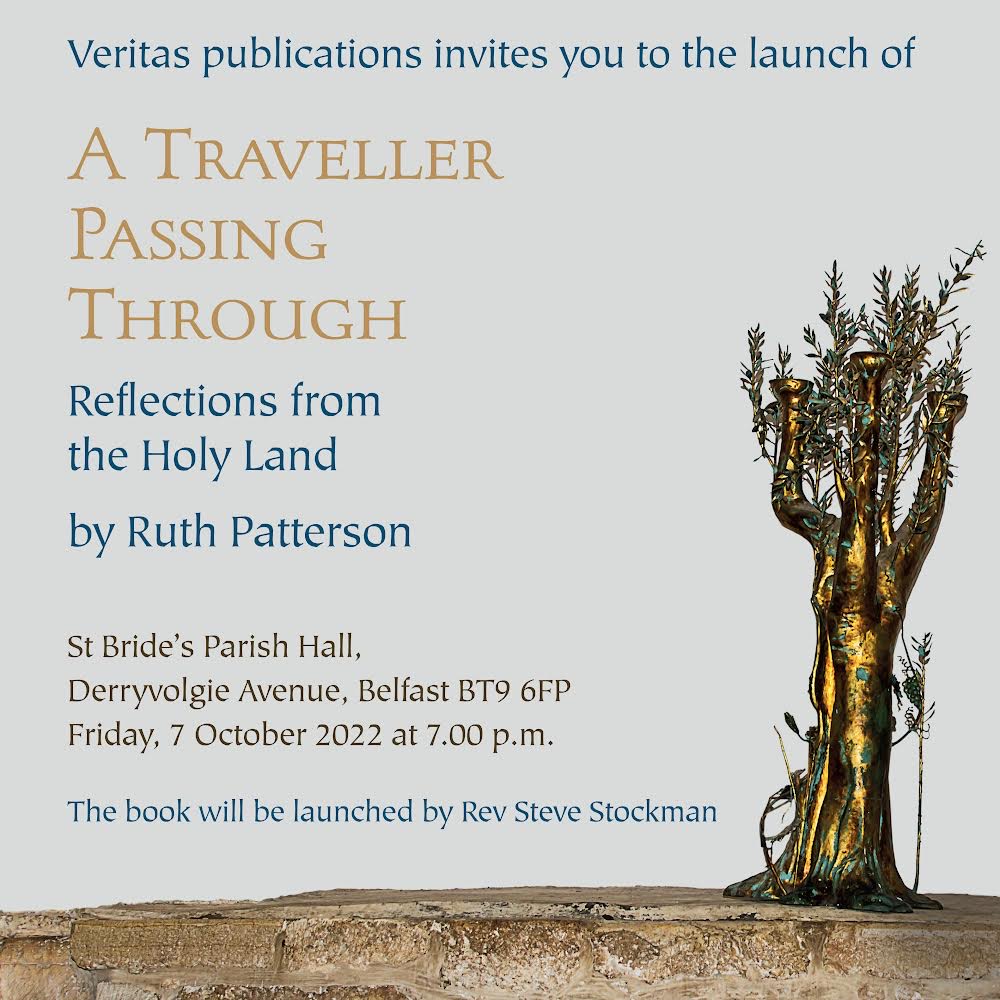
Ruth Patterson’s book: A Traveller Passing Through
Brendan McManus SJ
Thanks for inviting me to launch this book, it is a real pleasure as I know Ruth from her work and the topic interests me greatly.
As a writer myself, I guess I’m interested to learn from someone of her experience and wisdom.
As a Jesuit priest, I’m amazed at the overlaps with Ignatian Spirituality, mainstream Christian theology I guess, it’s so real, earthy, fully human, and discerning; it’s more than just a guidebook for the Holy Land, rather it’s a synthesis of prayer, spirituality and social action/reconciliation.
As I write on similar themes, here are 10 reasons I wish I had written this book: